The Magic Number Is Five: Why Tiny Groups Outperform Everything Else
The internet gives you access to millions of people chasing the same goals you are. There are subreddits with two million members dedicated to productivity. Facebook groups for every conceivable niche. Discord servers for language learners, early risers, marathon trainers, people trying to quit smoking, people trying to start meditating, people trying to write novels before breakfast.
And none of it works. Not really.
The research is remarkably consistent on this point. Large online communities are terrible at changing behavior. People lurk. They scroll. They feel momentarily inspired by someone else's transformation photo or streak screenshot. Then they close the tab. Nothing changes. The tab might as well not have existed.
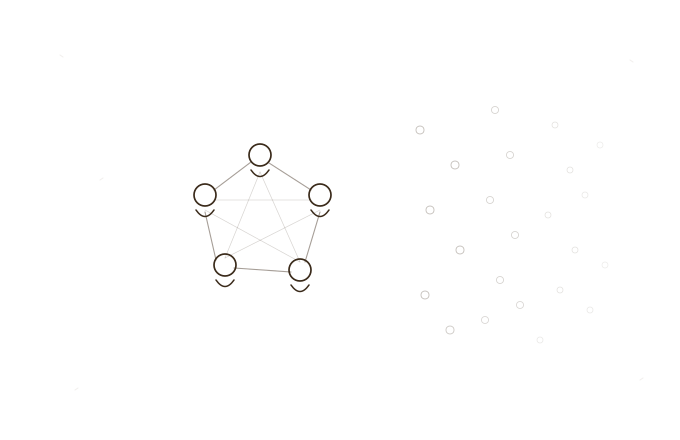
Meanwhile, the most effective accountability structures ever created are tiny. AA sponsors work in pairs. The best study groups are three or four people. Startup cofounders hold each other accountable in twos and threes. Workout partners, by definition, come in pairs. The pattern repeats across every domain where people are trying to change their behavior, and the number is always the same: two to five.
Always.
What the research says about group size
The Supportive Accountability model, developed by researchers at Northwestern, lays out what makes accountability actually function. Their core finding is that adherence to goals increases when people feel accountable to someone they perceive as trustworthy and benevolent, someone with whom they share a genuine relational bond. That bond is a prerequisite, not a nice-to-have. Without it, accountability collapses into nagging or, worse, into silence.
Try building that kind of bond in a group of five hundred people. You can't. Trust requires repeated interaction. It requires knowing someone well enough to care whether they notice you. In a subreddit, nobody knows your name. In a Discord server with three hundred members, your absence is invisible. But in a group of four people working toward the same goal, every person's presence or absence sends a signal that's impossible to ignore. When you don't show up, the group feels it. When you do show up, it matters.
The bigger the group, the easier it is to hide. Small groups invert this dynamic completely.
This connects to one of the more depressing findings in organizational psychology: social loafing. When groups get larger, individual effort diffuses. People contribute less because they assume someone else will pick up the slack, or because they correctly intuit that nobody's tracking their specific contribution. Research on virtual teams makes this worse, not better. Physical separation reduces social pressure, and the lack of face-to-face monitoring makes it easier to disengage without consequence. In larger groups, loafing isn't a bug. It's a predictable outcome of the math.
Small groups invert this dynamic completely. In a group of three, you're a third of the team. Your effort is visible. Your absence is conspicuous. There's nowhere to hide, and most people don't actually want to hide. They want to feel like their effort counts. Small groups give them that.
Products that prove this
You don't have to take the academics' word for it. The most engaging products in consumer tech have, sometimes intentionally and sometimes by accident, converged on small-group dynamics.
Snapchat Streaks are the clearest example. A streak is a bilateral accountability contract between two people. You send a snap, they send a snap, every single day, and if either person breaks the chain, it's gone. There's no group to absorb the loss. Internal data suggests users maintaining five or more active streaks spend significantly more time in the app daily and are substantially less likely to churn within ninety days. The mechanic works precisely because it's small. Two people. One shared commitment. Total visibility into whether the other person held up their end.
Strava tells a similar story from a different angle. The platform has over a hundred million registered users, but the engagement isn't coming from massive clubs or public leaderboards. It's coming from the fact that Strava's feed shows you specific people you know. Your running partner's morning five-miler. Your cycling friend's weekend ride. The social graph is small and personal even inside a large platform. Athletes in clubs are more than twice as likely to log weekly activity compared to solo users, but the clubs that drive that behavior tend to be tight-knit, not sprawling.
Even the world's most-used "accountability tools" operate at this scale without anyone calling them that. WhatsApp group chats. iMessage threads. The three-person text chain where you and two friends check in on your gym streak every morning. These are typically three to eight people. Nobody designed them as accountability products, but they function as exactly that because the group is small enough for every member to be individually visible.
What doesn't work at scale
Now look at what happens when products try to create accountability through scale.
BeReal hit 73.5 million monthly active users in August 2022. By early 2024, that number had cratered to roughly 23 million. The app's core mechanic, posting an unfiltered photo at a random time each day, broadcast to a wide audience of loose acquaintances. There was no obligation between specific people. No one in particular was waiting for your photo. No one in particular would notice if you skipped a day. The notification said "time to BeReal" but nobody in your life was actually saying it to you. Scale without relational density turned out to be an empty mechanic.
43Things told the same story a decade earlier. The site let people share goals publicly with a community of strangers, cheer each other on, and track progress together. It won a Webby Award. It grew to millions of users. And then it shut down, because public goal-sharing with strangers doesn't create the interpersonal obligation that makes people follow through. You could list "learn French" alongside a thousand other people listing the same thing, and the social pressure was exactly zero.
The pattern is always the same. Large numbers with thin connections produce lurking, not action.
Why "community" is the wrong frame
The productivity and wellness space is obsessed with community. Community-led growth. Community engagement metrics. Building community. Every other pitch deck in the space has a slide about the power of community.
But community is the wrong unit for accountability.
Community is great for some things. Information sharing. Inspiration. Identity formation. If you want to feel like a runner, joining a running community helps. If you want to learn what shoes to buy, a community of ten thousand runners will give you plenty of opinions.
But if you want to actually run tomorrow morning, you need something different. You need the specific behavioral mechanic where your individual effort, or your lack of it, is noticed by specific people whose opinion you value. That doesn't happen in a community of thousands. It happens in a group small enough that your name is known and your absence is felt.
A community is a place you visit. A crew is a group that notices when you don't show up.
Those are fundamentally different social structures, and they produce fundamentally different outcomes.
The design consequence
This is why Crewmates is built around crews of two to six people, not open communities. The small number is the entire point.
Everything in the product, the shared habit grid, the visibility into who's active, the crew streak that breaks when any single member misses, is designed for the scale at which individual participation is visible and individual absence is felt. Make the product bigger and you lose the mechanic that makes it work. The constraint is the feature.
The internet is full of places to share your goals with thousands of people. Crewmates is a place to share them with the three people who'll actually notice if you stop.