You Don't Need Another Productivity App. You Need People Who Notice.
You downloaded the app. You set up the habits, the to-do list, the goal tracker. Maybe you even customized it. Color-coded the categories. Configured the widgets. Set up the daily reminders at 7am, right when you wake up, because that felt like something a disciplined person would do.
For the first week, it worked. You checked things off. You felt the little buzz of completion. The streak counter ticked upward. You were, briefly, the person you wanted to be.
And then, quietly, without any dramatic moment of failure, you just stopped opening it. The reminders kept coming. You swiped them away. Eventually you turned them off. The app is still on your phone somewhere, probably in a folder called "Productivity" or "Self Improvement" that you haven't opened in weeks.
Nobody noticed.
That last part is the whole problem.
The solo tool graveyard
There are hundreds of beautifully designed productivity tools out there. They all do roughly the same thing: help you define what you want to do, remind you to do it, and track whether you did. Some of them are gorgeous. Some of them have won design awards. Some of them have incredibly thoughtful onboarding flows that make you feel, for about forty-five minutes, like this is the one that's finally going to work.
And they all share the same failure mode. The moment you stop showing up, nothing happens. The app doesn't care. Your streak resets silently. Your to-do list just sits there, patient and indifferent, waiting for you to come back. Or not.
These aren't numbers about bad apps. These are numbers about all apps. The beautifully designed ones, the award-winning ones, the ones with five-star ratings and glowing press coverage. The pattern holds.
And here's what's important: this isn't a story about people being lazy or flaky. It's a story about tools that create zero social cost for disengagement. When you stop using a habit tracker, the only person who knows is you. And you're already pretty good at negotiating with yourself.
Why reminders don't work (but a text from your friend does)
That stat alone should tell you everything about how well automated reminders work as a retention strategy. People don't just ignore push notifications. They actively resent them enough to delete the entire app.
And yet. A single text from a friend saying "you coming to the gym?" has a near-100% read rate. You don't swipe that away. You don't mute that thread. You might say no, but you'll read it, and you'll feel something when you do.
The difference isn't about the information being conveyed. "Time for your daily workout!" and "you coming to the gym?" contain roughly the same prompt. The difference is that one comes from an algorithm that doesn't care whether you show up, and the other comes from a person who does. The algorithm will send the same notification tomorrow regardless. Your friend will notice your absence.
An app can ping you. Only a person can make you feel seen.
Effective accountability requires something that no solo productivity tool can manufacture: a person who's actually in the arena with you. Someone whose own effort is bound up with yours. Someone who has standing to ask how it's going, because they're going through the same thing.
What "social" actually means (and what it doesn't)
This is where it gets tricky, because plenty of apps have tried to bolt social features onto productivity tools. Leaderboards. Public goal-sharing. Community forums. Challenges with strangers. The track record is not great.
43Things was a social network built entirely around goal-sharing. You'd list your goals, strangers would "cheer" you on, and you could browse what other people were trying to accomplish. It won a Webby Award in 2005. It grew to around three million users. And it shut down in 2015, because public sharing without relational depth doesn't actually create obligation. Posting your goals to strangers creates a brief hit of optimism, maybe even a little dopamine, but no sustained accountability. You don't really care what strangers think about whether you meditated today. Why would you?
Leaderboards among people you don't know trigger comparison and anxiety, not support. Community forums diffuse responsibility so widely that no individual's absence registers. These features feel social, but they're missing the thing that makes social dynamics actually work: a small number of people who know you, who are pursuing something alongside you, and whose effort you can see.
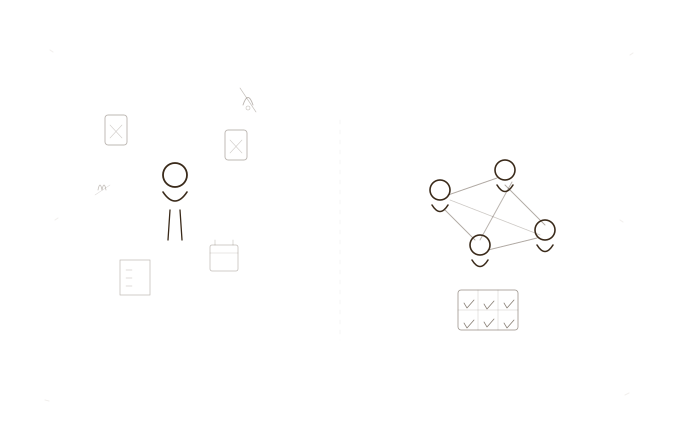
The research on this is pretty consistent. Groups of two to five outperform both solo efforts and large communities when it comes to sustained behavior change. The reason is simple: in a group that small, each person's participation is individually visible. Your presence matters. Your absence is felt. You can't hide in the crowd, because there is no crowd. There's just your crew, and they can see your empty row in the grid.
The shift
So what if we built the tool differently?
Not an app designed to remind you, but one designed to make your effort visible to people you actually care about. Not a notification engine, but a shared space where the most powerful feature isn't the habit tracker itself, but the fact that three other people can see whether you showed up today.
What if the app didn't need to send you a push notification at all, because the ambient awareness that your crew was already active this morning was enough? Not a leaderboard. Not a public feed. Just a small, quiet signal that the people you're in this with are doing their part. And they can see whether you're doing yours.
That's a fundamentally different kind of motivation. It's not gamification. It's not guilt. It's the simple, ancient human experience of not wanting to be the one who didn't show up when everyone else did.
You don't need a better app
The graveyard of abandoned productivity tools on your phone isn't evidence that you lack discipline. It's evidence that discipline was never the problem. The tools gave you everything except the one thing that actually works: other people.
You don't need a better app. You need a crew.
We're building Crewmates for exactly this. If that sounds like something worth trying, join the waitlist.