Why We're Building Crewmates
Four of us made a pact last January. We were going to apply to jobs together. Not in some vague, aspirational way. We made a shared Google Sheet with columns for company name, date applied, status, and notes. We pinned it in the group chat. Everyone said something encouraging. It lasted about eleven days.
Nobody announced they were quitting. That's the thing. The sheet just went quiet. One person stopped updating for a few days. Then another. The group chat kept going, obviously, because group chats always keep going. Memes, links, complaints about landlords. But the spreadsheet sat there, untouched, slowly sinking under newer messages until you'd have to scroll to find it. By February, it was a relic. Nobody mentioned it. We all still needed jobs.
The goals were real. The tools were fine. Google Sheets works. What didn't work was that nobody was watching.
What we kept noticing
That spreadsheet situation wasn't unusual. If anything, it was completely standard. Every friend group has some version of it. The gym accountability chat that fizzles by week three. The shared Notion board for the side project that two people stop opening. The "let's all read one book a month" thread that produces exactly one month of enthusiasm.
And it kept bugging us, because in every one of these cases, people genuinely wanted to do the thing. Nobody joins a gym accountability group as a joke. Nobody sets up a shared spreadsheet for fun. The desire was there. The follow-through collapsed anyway.
We started paying attention to when it didn't collapse. When the follow-through actually stuck. And the pattern was always the same: someone was watching. Not monitoring, not judging. Just... present. Aware. A study group where everyone could see who showed up and who didn't. A running club where your friend would text you if you missed Tuesday's session. A coworker who asked about your side project every Monday, and you didn't want to keep saying "I didn't work on it."
The moment effort became invisible, it became optional.
The difference between those situations and the dead spreadsheet was simple. In one, your effort was visible. In the other, it was invisible. And the moment effort became invisible, it became optional.
The gap nobody's filled
There's no shortage of productivity tools. Notion, Todoist, Apple Reminders, Google Calendar, Habitica, a dozen habit trackers. They're good at what they do. They help you organize tasks, set reminders, build routines. But they all share the same fundamental design assumption: you, alone, will be motivated enough to keep using them. When motivation dips, the app doesn't care. You just stop opening it, and nothing happens. No one notices. No one reaches out. Your streak resets silently, and that's that.
On the other end, there are group chats and shared docs. Those have the human element, but zero structure. "Did you go to the gym?" gets buried under thirty messages about what to eat for dinner. The shared Google Doc goes stale because there's no natural reason to open it every day. Accountability check-ins feel awkward to initiate and easy to ignore.
Strava figured this out for running and cycling. They proved that the simple act of making your activity visible to people you respect is one of the most powerful behavioral motivators available. That one-tap acknowledgment, that tiny "I see you," turns solitary effort into something shared.
But Strava only works for exercise. There's nothing like it for the rest of your goals. No shared space where your crew can see whether you studied today, applied to that job, worked on the side project, cooked instead of ordering takeout. The structured-tool world and the social world have never properly merged. You get one or the other.
What we're building
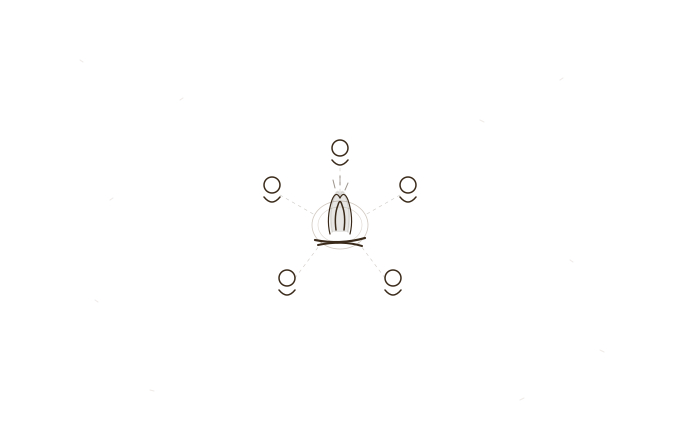
Crewmates is a shared dashboard for small groups. You and your crew, two to five people, get a workspace you can see together. Habits, calendars, to-dos, notebooks. All in one place, all visible to the people who matter to you.
When your crewmate checks off their morning run, you see it. When you don't check off yours, they notice the gap. Nobody has to send the awkward "hey did you do the thing?" text. The empty cell in the grid does the talking.
That's really the whole idea. We're not building a project management tool or another habit tracker or a social network. We're building for the space between solo productivity apps and group chat chaos. A place where your goals become a little bit everyone's business, in the best possible way.
What we believe
Goals are easier to pursue and harder to abandon when other people are watching, participating, and caring alongside you. The fundamental unit of this app isn't the individual user. It's the crew. The small group of people who actually give a damn whether you showed up today.
We think the reason so many goals die quietly is that they were never visible to begin with. Making them visible, giving them an audience of people you trust, changes the equation entirely.
Not through guilt or punishment, but through the simple, persistent awareness that someone is paying attention.
We're building this in the open, and we'd love for you to follow along.