The Empty Cell: Why What You Don't Do Is More Powerful Than What You Do
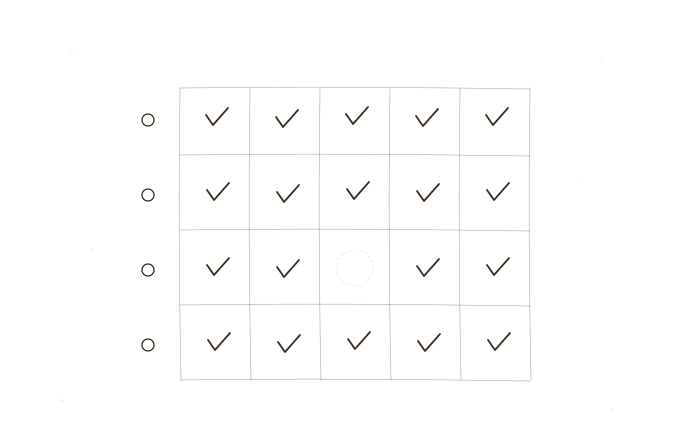
Picture a shared spreadsheet. Four friends tracking whether they worked out this week. Monday through Friday across the top, names down the side. Three rows have checkmarks filling in steadily. The fourth row is empty.
Nobody says anything. Nobody needs to. The empty row speaks with a clarity that no push notification, no motivational quote, no "don't forget to log your workout!" reminder could ever match. The person with the empty row knows it's empty. They know everyone else can see it. And that quiet visibility is doing more work than any feature a productivity app has ever shipped.
The most powerful motivational force might not be the check mark at all. It might be the absence of one.
This is the mechanic that most goal-tracking tools completely miss. They're obsessed with what you do: tasks completed, habits checked, streaks maintained, points earned. But the most powerful motivational force might not be the check mark at all. It might be the absence of one.
The products that already get this right
The strange thing is, visible absence isn't a new idea. Some of the most successful consumer products in the world are already built on it. They just don't talk about it this way.
Snapchat is the clearest example. Streaks aren't a reward for sending a snap. They're a threat. The streak counter sits there between you and a friend, ticking upward, and both of you can see it. Miss a day and it resets to zero, visibly, for both of you. The streak doesn't celebrate your consistency so much as it makes your inconsistency impossible to hide.
Roughly three-quarters of users report sending snaps specifically to keep streaks alive. That's not engagement driven by delight. That's engagement driven by the dread of a visible gap.
Strava works the same way, though it feels different on the surface. Strava's most motivating moment isn't seeing your friend's morning run pop up in the feed. It's opening the app, seeing that three people in your running club already logged their miles today, and realizing you haven't. Nobody tagged you. Nobody sent you a message. Your absence from the feed did all the work.
The social layer doesn't just add a nice-to-have. It fundamentally changes how often people show up.
Duolingo figured this out more recently with Friend Streaks, which let you maintain a shared streak with up to five friends. The individual streak was already powerful. Millions of people already felt guilty watching their personal counter reset. But making that counter visible to someone else transformed the feeling entirely. Your streak becomes a shared commitment. Letting it lapse isn't just a private failure anymore. It's something a friend can see.
Forest, the focus app, went even further. Their "Plant Together" feature starts a shared virtual tree that grows while everyone in the group stays off their phones. If one person opens an app, the tree dies for everyone. Four million people pay for this. The mechanic is pure visible absence: your failure doesn't just affect you. It shows up, immediately and undeniably, in a space your friends are watching.
The through-line across all of these products is the same. They don't succeed because they're brilliant tools. Plenty of apps can track runs or count lessons or set timers. They succeed because they make your inaction visible to someone whose opinion you actually care about.
Why a friend's silence hits harder than an algorithm's noise
There's a reason the empty row in that spreadsheet works better than the push notification you swiped away this morning. And it comes down to three conditions that accountability research has identified as essential for behavior change.
The first is trust. You have to believe that the person observing you isn't going to use your failure against you. A coworker on a team leaderboard might. A fitness influencer's community definitely will. But your close friend? The one who's also trying to run three times a week? You trust them. That trust is what makes the visibility feel safe rather than threatening.
The second is benevolence. The person watching has to want you to succeed. Not in a vague, motivational-poster way. In a real, invested, "I know you're going through it and I'm pulling for you" way. When your crew mate sees your empty row, the unspoken message isn't "you suck." It's "where are you? we noticed." That distinction changes everything about how the signal lands.
The third is legitimacy. The person holding you accountable has to be doing the same thing alongside you, not just watching from the sidelines. A life coach can give you advice. A friend who's tracking their own habits right next to yours can give you something more: the feeling that you'd be letting down someone who's putting in the same work. Peer support research consistently finds that groups of two to five people outperform both solo efforts and large communities, because in a small group, each person's presence (or absence) is individually noticed.
This is why a text from a friend in your study group asking "where were you?" carries ten times the weight of a push notification saying "don't forget to study!" The notification is impersonal. It came from a server. The friend is invested. They were there. They noticed you weren't.
BJ Fogg's behavior model breaks this down into three components: motivation, ability, and prompt. What visible absence does is supercharge all three at once. Motivation jumps because the behavior is socially meaningful. You don't go for a run because a progress bar told you to. You go because three people you respect will see whether you did. The prompt gets stronger because it comes from a person, not an algorithm. And ability matters because if it's easy to log your activity, the social signal fires quickly. If it takes twelve taps to check in, you won't bother, and nobody will ever see that you showed up.
The key insight is that all of this happens without anyone saying a word. There's no confrontation, no awkward check-in call, no passive-aggressive message. The empty cell in the shared grid does the talking. It's ambient accountability. It works in the background, all the time, with zero social friction.
Designing for what people don't do
Most productivity tools are designed entirely around what you do. Tasks completed. Habits checked. Goals achieved. The entire reward structure points in one direction: you did the thing, here's your dopamine.
But if the evidence from Snapchat, Strava, Duolingo, and Forest tells us anything, the most powerful motivational mechanic might run in the opposite direction: making inaction visible in a context where someone who matters can see it.
Think about what that means for product design. An empty cell in a shared habit grid. A grayed-out avatar on a "who's active today" indicator. A crew streak that everyone loses when one person breaks it. These aren't punishments. They're not designed to shame anyone. They're ambient signals that say "we noticed you weren't here."
The design edge is subtle but critical. Visible absence only works if the emotional tone is right. Social comparison can motivate people when it feels supportive, and it can crush them when it feels competitive. The difference between "your crew noticed you didn't show up and they're rooting for you to come back" and "you're in last place on the leaderboard" is the difference between a product people return to and a product they delete. Support, not surveillance. Encouragement, not ranking.
The smaller the group, the louder the silence.
This is also why small groups matter so much. In a feed with hundreds of people, your absence is invisible. Nobody notices when one person out of a thousand doesn't post. But in a group of four? Your empty row is a quarter of the grid. It's felt. It registers. The social weight of your presence, or your absence, scales inversely with group size.
And the mechanic compounds over time. A shared streak isn't just today's accountability. It's every day's accountability, stacked on top of each other, visible to everyone. Breaking a 45-day crew streak doesn't just mean you missed Tuesday. It means you reset something the whole group built together. The longer the streak, the higher the social cost of absence, and the more powerful the invisible pull to show up.
None of this requires surveillance. None of it requires nagging. None of it even requires your friends to say anything. The structure does the work. The visibility is the feature.
What this is really about
Strip away the product language, the behavioral models, the engagement metrics. What you're left with is something simple and deeply human.
The best accountability partner you've ever had wasn't an app. It was a person who cared enough to notice when you didn't show up, and whose own effort made you not want to let them down. The empty cell just makes that ancient dynamic work at scale.
That's what we're trying to build.